Henry Isaac Page
Our Chemical HeartsHenry Isaac Page is a seventeen-year-old whose cautious, bookish self-image is unsettled by his growing attachment to Grace Town. At the start of senior year, he has little romantic experience, concentrates on school and writing, and has spent two years working toward the student newspaper’s editor’s desk. His first kiss with Grace turns that ambition for a safely orderly life into a conflict: he wants her, yet already understands that loving her may expose him to sadness, grief, and jealousy.
Identity and Background
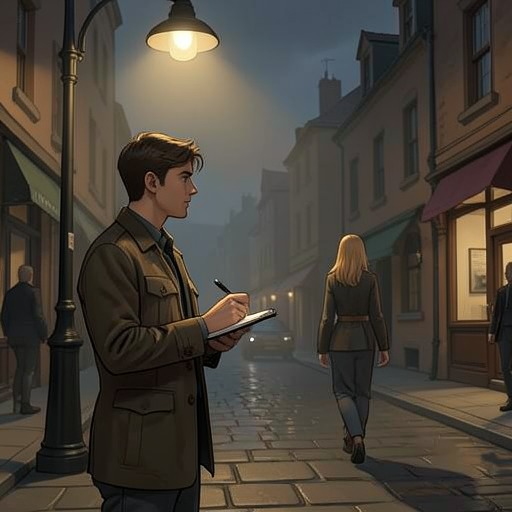
Henry describes himself as lanky, dark-haired, and socially unremarkable, with shoulder-length hair, dimples, and a particular fondness for his father’s eighties sports coat. His comic comparisons—to a young Keanu Reeves, a male Summer Glau, or Severus Snape—make appearance part of his self-mocking narration rather than a claim to conventional confidence. The same humor governs his account of his uneventful life: while the opening week of senior year produces school scandals, he presents himself as entirely removed from them.
His lack of romantic experience is more than a temporary gap in a dating history. Henry says that after puberty he did not develop the desire for a relationship that seemed ordinary among his peers. Earlier childhood attachments—a kindergarten kiss and a prolonged idea of marrying a classmate—had not carried into adolescence. At seventeen, he is still uninterested in girls or boys in that way, and is content to focus on grades and the prospect of getting into a decent college. This self-description establishes the distance between Henry’s expectations and the intensity of what he later feels for Grace.
Writing and the Editor’s Desk
Henry’s emerging ambition to write is tied to Alistair Hink, his English teacher and the faculty organizer of the student newspaper. When a late-running math class cuts into an English lesson, Hink objects to the lost time and argues that the arts are no less valuable than mathematics. Henry recalls that defense as the moment he fell in love with the idea of becoming a writer. The incident makes his vocation less a sudden discovery of talent than a response to seeing artistic work treated as something worth defending.
He already considers himself a capable writer, with an instinct for how sentences should be punctuated. He jokes that this grammatical intuition is a modest superpower, but it has helped him connect with Hink. Henry has volunteered for the paper since sophomore year, explicitly hoping to become its editor. When he finally sits at the editor’s desk, turns on its computer, and logs into the editor’s account, he pauses to savor an achievement he has worked toward for two years. The concrete ritual of taking his place makes the appointment feel earned, not merely bestowed.
That satisfaction is quickly complicated by Grace, who tells him she will not write editorials, opinion pieces, or any words for the paper. She is willing to help in other ways, but leaves the writing to him. Henry accepts the arrangement and says that he hopes not to do much writing himself, since Hink expects student volunteers to help. The contrast is revealing: the position Henry has pursued as a writer immediately requires him to negotiate both Grace’s terms and his own reluctance to carry the paper’s words alone.
Grace Town and the First Kiss
Henry’s early encounters with Grace unsettle the emotional detachment he has described. While the two watch fish, she hushes him so they will not be frightened away. He falls quiet, watches the fish and Grace, and tries not to imagine kissing her. The scene joins attraction to restraint: Henry notices the intimacy of simply sharing her attention, but his desire remains, for the moment, unspoken.
Grace asks whether he has ever had a girlfriend. The question makes his heart race, and his answer—that he has not, really—exposes the inexperience he has treated as an ordinary fact about himself. His response is brief, but the bodily reaction marks a change in its meaning. The subject of romance, previously remote from his plans, becomes charged because Grace is the one asking.
The first kiss brings that tension into the open. After Henry begins to say that he would understand if Grace did not want something, she takes him by the collar and kisses him intensely. Murray Finch and Lola Leung are waiting in the bus line and watch the pair, leaving Henry embarrassed and eager to get away. Yet the public awkwardness is only the surface of the moment. Henry experiences Grace’s kiss as an act of urgent need and lets her draw breath from his lips; in the same instant, he understands that involvement with her may repeatedly hurt him.
Foreboding and Narrative Significance
Henry’s response to the kiss holds attraction and apprehension together rather than allowing one to cancel the other. He imagines the road ahead as marked by grief, sadness, and jealousy, and describes Grace as a jagged piece of glass on which he might cut himself again and again. The image makes his awareness of risk immediate, but it does not make him indifferent: he has already been moved by her presence, and the kiss confirms the depth of his desire even as it warns him of its cost.
He also remembers the Pablo Neruda poem Grace had given him, still folded in his wallet since the first day she gave it to him. Thinking of loving her in secret, between shadow and soul, Henry considers whether his feelings belong in darkness rather than in a relationship made real. This is a provisional response, not a settled decision. In these early scenes, Henry’s defining movement is from detachment toward emotional exposure: the boy who expected to remain outside romance becomes someone who can foresee heartbreak and still be drawn toward Grace.